1. Stable, Non‑Inflating Questions You Can Use
The subconscious needs to be kept in proportion mode, not magnitude mode — which is why percentage charts remain stable. Here are questions that maintain this proportion focus:
BG3 Expression
"Indicate the percentage expression of BG3 present in this object."
Lifeforce Proportion
"Indicate the percentage expression of optimal lifeforce this plant is expressing."
High‑Vibrational Energy
"Indicate the percentage expression of high‑vibrational energy active here."
Field Coherence
"Indicate the percentage expression of coherence this field currently holds."
Harmonisation Level
"What percentage of maximum harmonisation is this space expressing?"
Vibrational Degree
"Indicate the percentage degree of high vibrational energy."
Lifeforce Presence
"Indicate the percentage of lifeforce energy present."
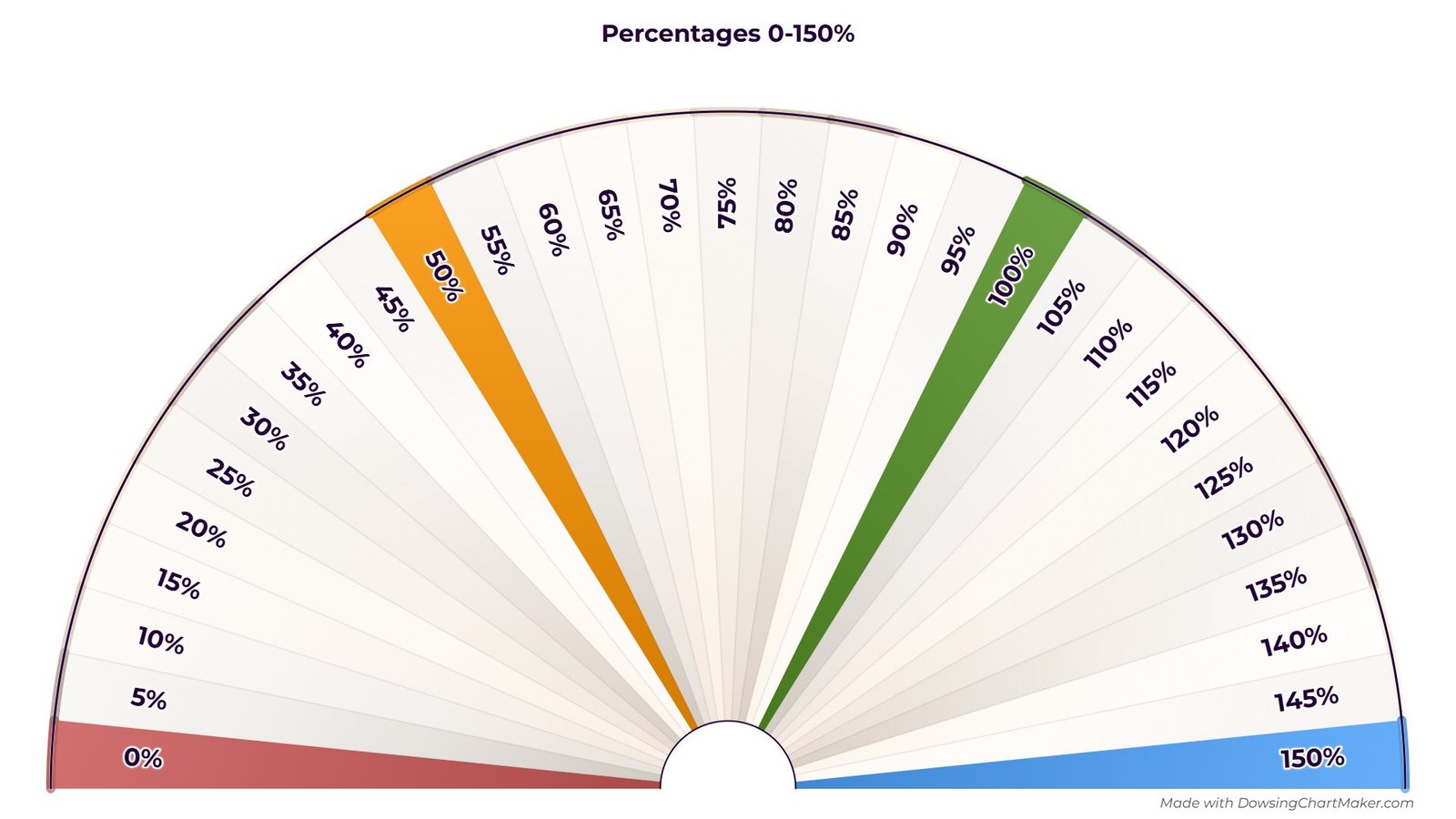
Click the image to view full size. The 0–150% percentage chart — bounded, non‑inflating, and ideal for measuring expression.
2. Why Percentage Charts Behave Well
Percentage charts have five key properties that make them the most reliable numeric tool in dowsing. Unlike open‑ended numeric scales, percentage charts measure something bounded, proportional, and immune to the inflation patterns that plague Bovis scales and other open numeric systems.
3. They Are Bounded
A percentage chart is always 0% → 100%. The subconscious cannot escalate beyond the boundary. This prevents the “millions → billions → trillions” inflation seen in open‑ended numeric charts.
4. They Measure Expression, Not Quantity
When you ask “What percentage of BG3 is present?” you are not asking how much BG3 exists in the universe or what the absolute energy level is.
You are asking: “How fully is BG3 being expressed in this object right now?”
This is a qualitative proportion, not a numeric magnitude. The distinction is critical. Quantity can inflate; expression stays grounded in what’s actually happening in the moment.
5. They Avoid Symbolic Inflation
Percentage charts do not trigger the common inflation patterns that corrupt other numeric dowsing scales:
Repeating Digits
The subconscious will not produce 11:11, 22:22, or 33:33 on a percentage chart. The bounded scale eliminates this pattern.
Harmonic Stepping
Open scales produce values in harmonic progressions. A percentage chart removes the room for this escalation.
Runaway Numbers
The “my number is bigger than your number” dynamic simply cannot happen on a 0–100 scale.
Cosmic Escalation
Values remain grounded in the object being measured rather than drifting into metaphysical amplification.
Operator‑Identity Inflation
The operator’s ego doesn’t get to claim larger and larger numbers as proof of spiritual progress.
6. They Work for ANY Subtle‑Field Category
One of the most powerful properties of percentage charts is their universality. You can measure any subtle‑field category without inflation:
- BG3 expression — how fully a BG3 harmonic is present
- Lifeforce proportion — the degree of vital energy being expressed
- High‑vibration percentage — how elevated the energetic state is
- Field coherence — how well the energetic field is integrated
- Harmonisation level — the degree of resonance and balance
All without inflation. A single percentage chart can replace multiple Bovis scales, frequency charts, and harmonic step charts — while providing more reliable results.
7. They Avoid Spiritual Hierarchy
Percentage charts prevent the escalation patterns that lead to competitive or metaphysical inflation:
- “My energy is bigger than yours”
- “My field is larger”
- “I raised the moon yesterday”
- “I am the conduit of the Creator”
Because percentages measure expression, not status. This makes them ideal in group settings where open‑ended numeric scales can trigger competitive escalation. No one can claim “higher” numbers because the scale is the same for everyone.
8. Why a 150% Scale Is Ideal
In his own work, Rhodney found that a 0–150% scale is a sweet spot where the subconscious can express proportion without slipping into inflation.
A 150% chart is still bounded, just slightly extended:
- 0% → 100% = full expression
- 100% → 150% = enhanced or over‑expression
This gives the subconscious room to express BG3 resonance, lifeforce intensity, high‑vibration states, and coherence peaks — without forcing it into runaway numbers. It remains a closed system, so it does not inflate.
Share Your Experience
Have you tried percentage charts for subtle‑field measurement? Share your experiences and help us understand how bounded scales perform in different dowsing contexts.